
Obesity Management Quality Improvement Collaborative Infographic

Participating HCO Intervention Successes, Organized by AMGA Obesity Care Model (Obesity Care Model Collaborative) Domains
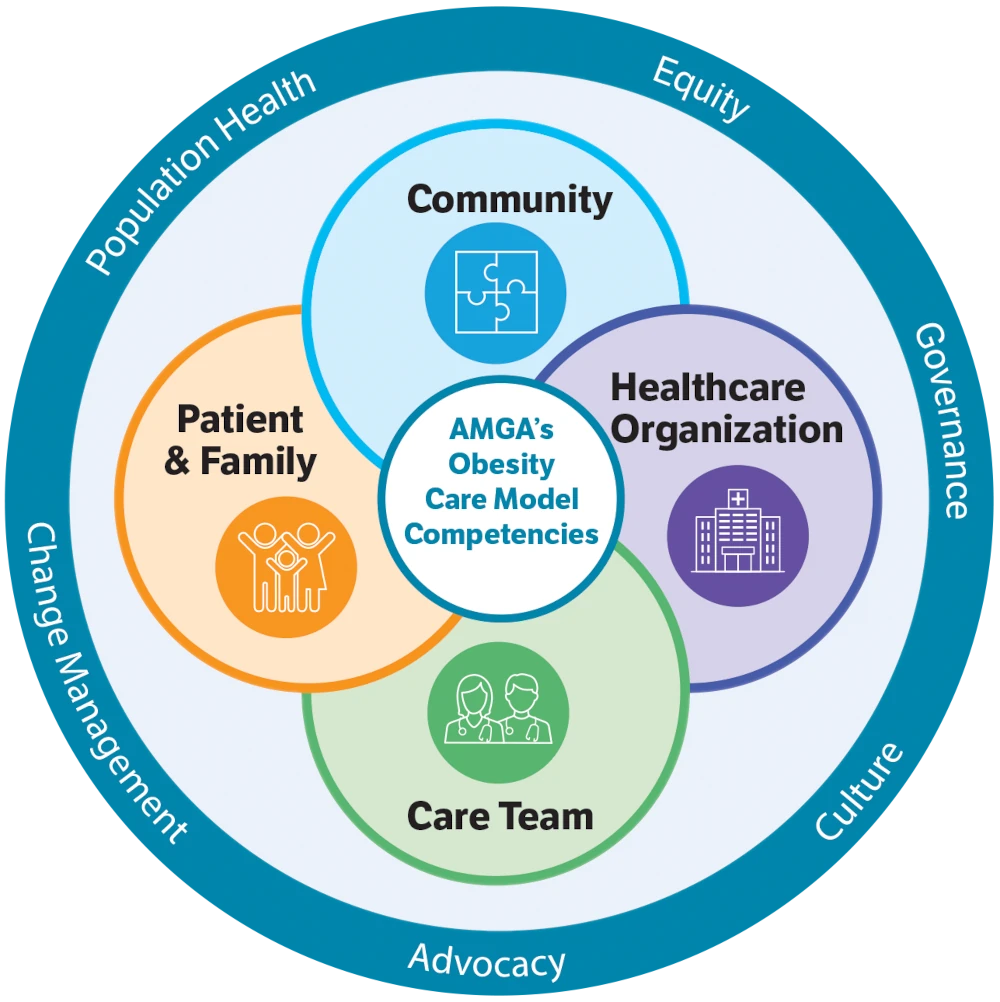
This Infographic maps each participating HCO's successful interventions to the four AMGA Obesity Care Model domains, Community, Healthcare Organization, Care Team, and Patient & Family, as defined in AMGA's Obesity Care Model Playbook.
*Rate note: Rates show each healthcare organization’s Collaborative-level Measure 1 (Obesity Diagnosis) or Measure 2d (Any Obesity Treatment) rate from Baseline (Jun.–Aug. 2025) to Final (Mar. 2026 – May 2026). Measure 1 is the rate of adults with BMI ≥ 30 who have an active documented diagnosis of obesity. Measure 2d is the rate of adults with BMI ≥ 30 who received a guideline-recommended obesity management treatment.
Community
Building relationships with, and engaging, local and external organizations to provide services to patients with obesity.
Successful Intervention: Rolled out an social drivers of health (SDOH) screener across all Medical Weight Management (MWM) services. Primary Care MWM specialist trained to connect patients to Find Help resources for food security and physical activity, directly targeting Advocate’s stated vulnerable population (high-SDOH-score patients).
Rate (Baseline → Final)*: Referral tracking report in process; not yet quantified in the action plan.
Healthcare Organization
The medical group/health system’s administrative, financial, clinical, and electronic health record (EHR) initiatives that develop and support obesity care delivery.
Successful Intervention:
Launched an employee weight-loss challenge (Mission SlimPOSSIBLE!) with three monthly mini-challenges; ~15% employee participation and 3.81% cumulative weight loss among participants.
Presented obesity data and progress at practice meetings six times across the collaborative and distributed physician/NPI-level baseline, midpoint, and final performance reports.
Built and piloted an obesity care pathway in the EHR to support consistent diagnosis and treatment workflows (piloted 11/1/25, revised 11.24.25 after workflow feedback, later updated for the CMS GLP-1 Bridge Program).
Health Equity Project: developed education materials and physician-level reports on the 7-point obesity-diagnosis gender gap; narrowed the gap by nearly 3 points by the May 2026 practice meeting.
Rate (Baseline → Final )*: Measure 1 (Diagnosis): 64.8% (BL) → 87.3% (Final)
Successful Intervention: Hosted an Obesity Summit offering 4 CME credits with 12 Advocate Health experts and 14 exhibitors; drew 90 in-person and 239 virtual attendees (407 registered). Ran an AOM-prescribing MEDTalk (163 attendees) and expanded Bariatric Surgery bias/stigma workday training to all weight-management staff.
Rate (Baseline → Final )*: Measure 1: 61.8% (BL) → 61.3% (Final)
Successful Intervention: Physician Champion delivered recurring primary care physician (PCP) education (PHSO Quality, Internal Medicine, Family Medicine, and CC meetings) on GLP-1s, bias, and health equity through Q1 2026, continuing via PC Ops meetings. Deployed a previously faculty-only weight-management SmartSet out to Community Care practices, and partnered with PharmD on a GLP-1 payer-coverage quick-reference guide.
Rate (Baseline → Final )*: Measure 1: 57.8% (BL) → 60.5% (Final)
Successful Intervention: No healthcare-organization-level (administrative/EHR/staff-education) intervention was documented in NHMG’s final action plan; its interventions centered on patient engagement and multidisciplinary care (see those domains).
Rate (Baseline → Final )*: Measure 1: 41.8% (BL) → 48.7% (Final)
Successful Intervention:
Partnered with the diagnosis-accuracy team to retrain staff on Epic problem-list entry and coding (rolled out March 1, 2026) and ran a 56-clinician Maintenance of Certification (MoC) cohort on obesity management.
Trained clinicians on respectful, weight-neutral language and personal bias reflection as part of the same MoC series.
Organized an Epic workgroup to embed a new obesity treatment algorithm and improve SmartSets, Notes, and the BMI Wizard.
Rate (Baseline → Final )*: Measure 1: 53.4% (BL) → 55.2% (Final)
Successful Intervention: Developed and implemented an Epic obesity SmartSet to support PCPs in obesity management, refined through 50+ rapid-cycle PDSA tests and live since 12/1/25, delivering real-time decision support at the point of care. In its first four months, the SmartSet drove 574 lab orders, 550 medication orders, 63 referrals, 14 e-consults, and 78 sleep studies. Offered a GLP-1 benefit within its self-insured employee health plan, now in its second program year.
Rate (Baseline → Final )*: Measure 1: 60.3% (BL) → 62.5% (Final)
Care Team
Medical group/health system care teams implementing initiatives that directly affect patient care.
Successful Intervention: Extended obesity-management education into specialties where excess weight worsens outcomes (pulmonology, rheumatology, women's health, pain management, and rehabilitative medicine/podiatry) folded into existing multispecialty practice meetings.
Rate (Baseline → Final )*: Measure 2d (Any Treatment): 18.2% (BL) → 24.7% (Final)
Successful Intervention:
Expanded GLP-1 e-visits in primary care (2,175 completed since Aug. 2025) and added FTEs/hours for Medical Weight Management providers, driving visit volume from 5,636 (Jun. –Aug. 2025) to 14,166 (Dec. 2025–Feb. 2026).
Launched a Virtual Enterprise Weight Management program across Wisconsin and Illinois; 919 internal referrals, 1,311 visits, and average scheduling lead time cut from ~90 to 15 days (WI) and 64 to 36 days (IL).
Piloted virtual group visits and integrated an eating-disorder-program referral pathway through Find Help.
Rate (Baseline → Final )*: Measure 2d: 20.5% (BL) → 24.4% (Final)
Successful Intervention: Placed 5,980 bulk referrals to lifestyle management (11.21.25 – 3.1.26) and enrolled 300+ patients in the UCSD Coach engagement platform, while working toward self-enrollment to reduce staff workload.
Rate (Baseline → Final )*: Measure 2d: 21.6% (BL) → 55.9% (Final)
Successful Intervention: Launched a Virtual Weight Management Clinic offering nutritional counseling, exercise planning, behavioral support, and medication management with pharmacist involvement, directly targeting time, transportation, and scheduling barriers. Built a care guideline connecting primary care, specialists, nutrition, behavioral health, PT, and pharmacy, plus proactive EMR-based outreach (MyChart messages + follow-up calls) to patients with BMI > 35.
Rate (Baseline → Final )*: Measure 2d: 22.8% (BL) → 31.1% (Final)
Successful Intervention: Ran three half-day work sessions to build a new weight-management treatment algorithm (modeled on Advocate Health’s), created a new patient education packet, and launched a weight-management champion clinician program alongside Epic GLP-1 prescribing tools.
Rate (Baseline → Final )*: Measure 2d: 25.2% (BL) → 28.4% (Final)
Successful Intervention: Developed and implemented an Epic obesity SmartSet to support PCPs in obesity management, refined through 50+ rapid-cycle PDSA tests and live since 12.1.25, delivering real-time decision support at the point of care. In its first four months, the SmartSet drove 574 lab orders, 550 medication orders, 63 referrals, 14 e-consults, and 78 sleep studies.
Rate (Baseline → Final )*: Measure 2d: 30.4% (BL) → 32.0% (Final)
Patient & Family
Patient- and family-centered interventions that build relationships and partnerships among practitioners, patients, and their families.
Successful Intervention: Redesigned patient-facing weight-management websites and a bariatric program video to improve patient enrollment process. To improve and increase patient education tools built Epic SmartText patient handouts (medication guides, protein handout, “Plan on a Page,” Care Companion) embedded directly into the EHR smartest.
Rate (Baseline → Current)*: Tracked via webform-generated leads; not yet quantified.
Successful Intervention: For its Medicaid vulnerable population, the PHSO Outreach team placed live calls to schedule visits and added appointment-deck alerts reminding PCPs to address each patient’s obesity diagnosis—labor-intensive but focused directly on this at-risk group.
Rate (Baseline → Current)*: Patient-level outreach effort; not tied to a diagnosis/treatment rate.
Successful Intervention: Partnered with Novant’s marketing team to distribute culturally tailored obesity education (English and Spanish) via Instagram and Facebook; while direct social engagement didn’t spike, providers reported a “bleed-over” effect with more patients asking about weight-management options in visits.
Rate (Baseline → Current)*: Qualitative outcome; not tied to Measure 1/2d.