
“Without deliberate team design and market-aligned staffing levels, groups will experience negative impacts on access, turnover, and patient experience.”
ALEXANDRIA, VA — Results from the recently released AMGA 2026 Medical Clinic Staffing Survey indicate that while the pace of work accelerates at medical groups and health systems nationwide, groups continue to experience decreased staffing within the clinic. In the face of intense industry pressures, from reimbursement shifts to labor shortages, these staffing trends suggest that medical groups are increasingly operating with fewer resources.
The survey, conducted by AMGA Consulting, found that median total clinic staff (including clinic leadership) per provider FTE (physicians and advanced practice clinicians, or APCs) fell to 2.17 FTEs. That is down 0.12 FTEs per provider from the prior survey year, after holding steady at 2.29 for the three previous survey years. The steepest declines were in clinical support and ancillary roles. Clinical support and direct patient care staff (registered nurses, licensed practical nurses, and medical assistants) fell by 0.19 FTEs per provider, from 1.48 to 1.29. Ancillary staff, including radiology and laboratory staff, fell by 0.06 FTEs, from 0.33 to 0.27.
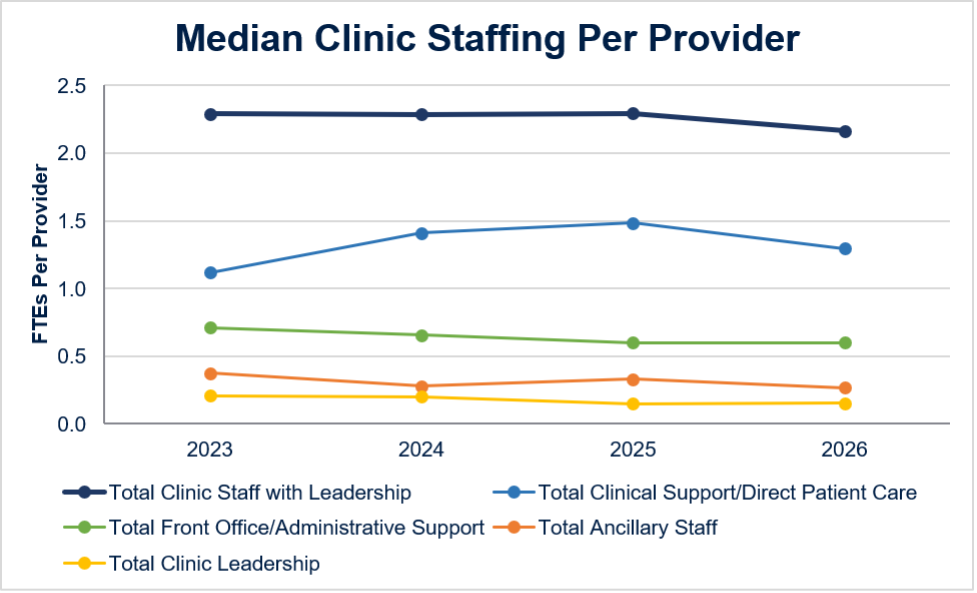
Since the 2023 survey, clinic staffing has shifted toward direct patient care. Front office and administrative support staffing and ancillary staffing both decreased by 0.11 FTEs per provider (0.71 to 0.60 and 0.38 to 0.27, respectively), while total clinical support/direct patient care increased by 0.17 FTEs (1.12 to 1.29), reflecting a greater investment in staff working alongside providers. The mix of roles within clinical support has changed too. Medical assistants per provider increased by 0.11 FTEs (0.77 to 0.88), while registered nurses fell by 0.07 FTEs (0.33 to 0.26) and licensed practical nurses fell by 0.14 FTEs (0.27 to 0.13).
In addition, the AMGA 2026 Medical Group Compensation and Productivity Survey showed that the pace of work continues to accelerate. Nationally, providers saw a 2.4% increase in wRVUs and a 2.0% increase in patient visits over the preceding year.
“Provider productivity is still climbing, as are the number of patient visits a provider experiences per year. But in the past year alone, each provider lost more than a tenth of an FTE of clinic-aligned support, and the largest decline was in the clinical support roles,” said Matthew Wells, senior director, AMGA Consulting. “Medical groups are also restructuring care teams. They’re leaning more on medical assistants while nursing levels decline, and certain functions are being centralized within larger health systems. Every member of the clinic team is being asked to carry a heavier load. Without deliberate team design and market-aligned staffing levels, groups will experience negative impacts on access, turnover, and patient experience.”
Staffing levels per provider vary by organization and specialty type. Independent medical groups reported a median of 2.63 total clinic staff (including leadership) per provider, compared with 2.11 for system-affiliated groups. Primary care clinics reported 2.39 staff per provider, compared with 2.00 for medical specialties and 2.01 for surgical specialties.
Heavier workloads can drive burnout and turnover among providers and staff. In the AMGA 2026 Medical Clinic Staffing Survey, clinics reported median total turnover of 13.0%. Medical assistants had the highest turnover at 16.4%, followed by front desk and support staff at 15.4% and registered nurses at 12.7%. Provider turnover was lower, at 9.2% for APCs and 6.2% for physicians.
As medical groups work to address access issues and provider shortages, many continue to rely on APCs. APCs now make up a median of 48.8% of clinic providers within a medical group. That share is similar across specialty types: 48.2% in primary care, 50.0% in medical specialties, and 48.7% in surgical specialties.
“Advanced practice clinicians now make up nearly half of clinic providers. That has expanded capacity, but the support staff around those providers hasn’t grown to match,” said Beth Pittman, director, AMGA Consulting. “The groups that stay ahead will be the ones that design care teams around how their providers actually practice. That means matching the right roles to the right work, rather than simply backfilling positions.”
Press copies are available. Please contact Taylor Martin for more information.
###
About the Survey
The AMGA 2026 Medical Clinic Staffing Survey is a confidential assessment of clinic staffing data and trends compiled by AMGA Consulting. It includes data from medical groups around the country, representing more than 6,500 clinics and more than 30,000 providers across primary care, medical, surgical, and other specialty-based areas. The report presents data organized by organization type, specialty type, and metrics, including FTEs per physician, per provider, per 10,000 wRVUs, and per 5,000 visits. The survey data is effective as of January 1, 2026, and is based on 2025 figures. To learn more and purchase the survey, visit AMGA’s website.
About AMGA Consulting
AMGA Consulting assists healthcare organizations in navigating the changing industry environment. AMGA Consulting builds clients’ organizational capabilities through effective governance, operational improvement, strategic alignment, talent management, provider compensation design, fair market value analysis, and total rewards solutions.
About AMGA
AMGA is a trade association leading the transformation of healthcare in America. Representing multispecialty medical groups and integrated systems of care, we advocate, educate, innovate, and empower our members to deliver the next level of high-performance health. AMGA is the national voice promoting awareness of our members’ recognized excellence in the delivery of coordinated, high-quality, high-value care. More than 175,000 physicians practice in our member organizations, delivering care to one in three Americans.